The Sweet Truth: How Sugar Affects Aging
If you've ever wondered whether the sugar in your morning coffee, granola bar, or cookie is doing more than just adding a touch of sweetness to your day, you're not alone. Sugar is one of the most talked-about topics in nutrition, and for good reason. What we now know about how sugar affects the aging body has grown significantly over the past decade, as have the options for sweeteners.


What Exactly Are We Talking About?
Before we dive in, it's worth understanding the difference between total sugars and added sugars, because this distinction matters. Total sugars include all the sugars found in a food, both naturally occurring sugars (like lactose in milk or fructose in fruit) and any added sugars[1]. Added sugars are sugars that are added during processing or preparation, including cane sugar, syrups, honey, and concentrated fruit juices. [2] Since 2016, the FDA has required manufacturers to list added sugars separately on the Nutrition Facts label, giving us a clear picture of how much sugar was actually added to a product. [2] This is beneficial because the sugars that naturally come in whole foods like milk and fruit come packaged with fiber, vitamins, and minerals and generally do not need to be limited. Added sugars provide calories without nutritional benefit, so these should be limited. [3]
How Much Sugar is Too Much?
The recommendations from major health organizations vary a bit, however they still are pretty consistent:
The Dietary Guidelines for Americans (2020-2025) recommends limiting added sugars to less than 10% of your daily calories. For someone eating about 2,000 calories per day, that's roughly 50 grams, or about 12 teaspoons. [1][4]
The American Heart Association is more strict, recommending no more than 6 teaspoons (25 grams) per day for women and 9 teaspoons (36 grams) per day for men. [5][6]
The World Health Organization recommends keeping added sugars below 10% of total energy, with additional benefits if you keep it below 5% (about 25 grams per day). [7]
To note, a single 12-ounce can of soda contains about 10 teaspoons of added sugar. [8] That's more than a woman's entire day's allowance in one drink!
How Sugar Affects How We Age
Sugar doesn't just add calories. At a cellular level, excess sugar promotes the formation of advanced glycation end products, or AGEs. These are harmful compounds that form when sugar binds to proteins, lipids, or nucleic acids in the body [9]. AGEs contribute to inflammation, oxidative stress, and tissue damage over time. [10]
What does this mean for you? Chronic exposure to AGEs has been linked to:
Skin aging [9][11]
Joint stiffness and arthritis
Damage to blood vessels and endothelial dysfunction
Accelerated aging of organs, including the kidneys[12]
So when you reduce your sugar intake, you're protecting your cells from age-related damage.
The Chronic Disease Connection
Excess sugar, especially from sugar-sweetened beverages, is a major driver of chronic disease.
Here's how:
Heart Disease and Diabetes: Sugar-sweetened beverages are a major source of added sugars in the diet and have been linked to weight gain, type 2 diabetes, cardiovascular disease, and some cancers. [13] A Tufts University study estimated that 2.2 million new cases of type 2 diabetes and 1.2 million new cases of cardiovascular disease occur every year from consuming sugar-sweetened beverages [14]. Habitual intake of SSBs is associated with about an 18% higher risk of cardiovascular disease even in physically active individuals. [14]
High Blood Pressure: Excess sugar promotes inflammation and endothelial dysfunction (damage to the lining of blood vessels), which contributes to elevated blood pressure.
Mortality Risk: Meta-analysis shows an 11% higher all-cause mortality risk with high sugar sweetened beverage intake, and a dose-response with approximately 8% increased mortality risk per additional daily serving. [15]
The Brain-Sugar Connection
One of the more surprising areas of research is the link between sugar and brain health.
Recent studies have shown:
A prospective cohort study of about 210,00 participants found that excessive sugar intake was associated with an increased risk of dementia. [16][17]
Systematic reviews show that all cohort studies and most cross-sectional studies found significant positive correlations between added sugar consumption and risk of cognitive decline.[18]
The 2025 Dietary Guidelines Advisory Committee systematic review found moderate quality evidence that dietary patterns higher in sugar-sweetened beverages are associated with an increased risk of age-related cognitive decline, mild cognitive impairment, dementia, and Alzheimer's disease.[19]
The mechanism likely involves chronic inflammation, insulin resistance in the brain, and damage from advanced glycation end products.[20]
Spotting Hidden Sugar
If you're trying to reduce your sugar intake, the biggest hurdle isn't dessert. It's the sugar hidden in everyday foods. Here are some surprising sources:
Sugar-sweetened beverages: the leading source of added sugars in the U.S. diet[3]
Desserts and sweet snacks: cookies, cakes, pies, ice cream[3]
Sweetened coffee and tea [1]
Condiments: ketchup, BBQ sauce, salad dressings, pasta sauce
Processed snacks: granola bars, flavored yogurt, instant oatmeal, protein bars
Breakfast cereals and granola[8]
Sugar goes by more than 61 different names on food labels. Watch for dextrose, maltose, turbinado, rice syrup, barley malt, evaporated cane juice, and fruit juice concentrate.[2]
What About Sugar Substitutes?
If you're trying to cut back on sugar, you might be wondering about substitutes. There are several options, and they're not all the same.
FDA-approved non-nutritive sweeteners (very low or zero calories) include six foodadditives[21][22]:
Saccharin (Sweet'N Low)
Aspartame (Equal, NutraSweet) — avoid if you have phenylketonuria (PKU)[22][23]
Acesulfame-K (Sunett)
Sucralose (Splenda) — heat-stable, about 600× sweeter than sugar[24]
Neotame (7,000-13,000× sweeter than sugar)[24]
Advantame (20,000× sweeter than sugar)[22]
Plant-based sweeteners approved by the FDA as generally recognized as safe (GRAS) include[25]:
Stevia
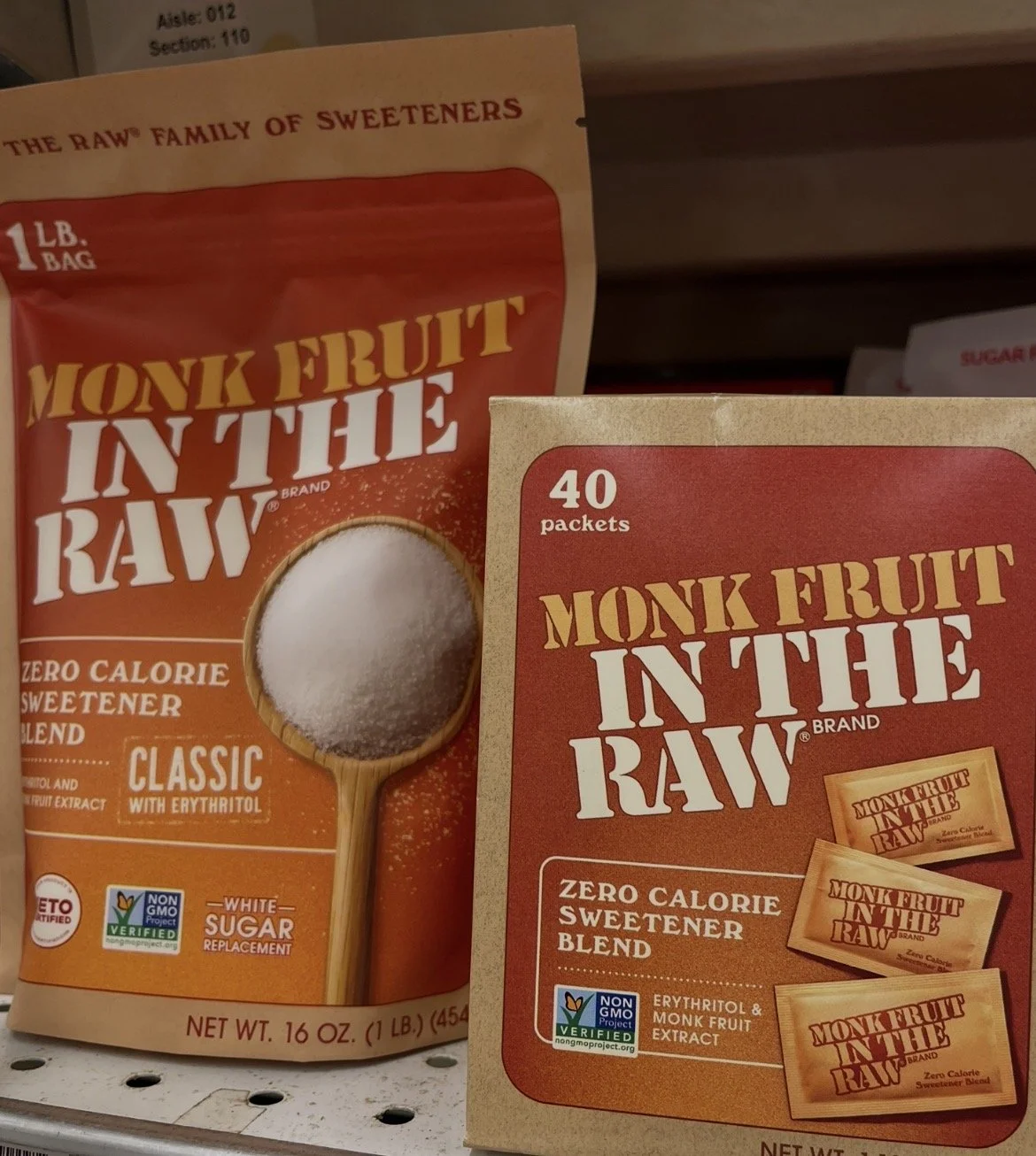
Monk Fruit
Sugar alcohols (polyols) like erythritol, xylitol, sorbitol, and maltitol are also used widely. They have fewer calories than sugar and don't raise blood sugar as much, but they can cause bloating and diarrhea, especially in larger amounts.
Safety Considerations:
The FDA has stated that scientific evidence supports aspartame as safe for the general population when used under approved conditions.[23][26]
In 2023, IARC classified aspartame as Group 2B, "possibly carcinogenic to humans," based on limited evidence for liver cancer. However, the WHO/JECFA risk assessment concluded that current evidence does not provide convincing evidence of harm at current use levels.[21] [27]
Recent studies have raised concerns about erythritol and xylitol, suggesting possible associations with increased cardiovascular events, particularly in older adults with existing cardiovascular risk factors. This is an evolving area of research.
The World Health Organization issued a conditional recommendation against using non-sugar sweeteners specifically for weight control. The recommendation does not apply to people using them to manage diabetes.
Making Small Changes That Add Up
If you're ready to decrease your added sugar intake, you don't have to completely change your diet overnight.
Here are five simple swaps you can make today:
Swap one sugary beverage for sparkling water or unsweetened tea
Choose plain yogurt with fresh fruit instead of flavored yogurt
Make your own salad dressing with olive oil, vinegar, and herbs
Choose whole fruit instead of fruit-flavored snacks
Read the label on every packaged product before you buy
These small changes can add up to a significant reduction in your daily sugar intake over time.
When to Talk to a Registered Dietitian
If you have a chronic condition like diabetes, heart disease, or kidney disease, a registered dietitian can help. Medicare Part B covers Medical Nutrition Therapy for people with diabetes or kidney disease, so it may be free for you. Many commercial insurers, including Blue Cross Blue Shield and Aetna, also cover Medical Nutrition Therapy as a preventive service.
Want personalized guidance? Schedule your first session here.
The Bottom Line
Sugar isn't all bad — the natural sugars in fruit and dairy come with beneficial nutrients. But added sugars, particularly from sugar-sweetened beverages and ultra-processed foods, are a different story. They contribute to chronic disease, cognitive decline, and accelerate aging at the cellular level. You can still have some sugar each day, however it’s best to take a close look at these items and see where you can cut back.
Reducing your added sugar intake is one of the most impactful things you can do for your long-term health. Start small, read your labels, and focus on whole, nutrient-dense foods. Your future self will thank you.
Please note: this blog post is for informational purposes only and does not constitute medical advice. Please consult with your healthcare provider or a registered dietitian for personalized nutrition guidance.
References
U.S. Department of Agriculture & U.S. Department of Health and Human Services. (2020). Dietary Guidelines for Americans, 2020-2025. dietaryguidelines.gov[1]
U.S. Food and Drug Administration. Added Sugars on the Nutrition Facts Label. fda.gov[2]
Centers for Disease Control and Prevention. Get the Facts: Added Sugars. cdc.gov[3]
U.S. Department of Agriculture. (2025). Scientific Report of the 2025 Dietary Guidelines Advisory Committee. dietaryguidelines.gov[28]
U.S. Food and Drug Administration. How to Understand and Use the Nutrition Facts Label. fda.gov[4]
CDC. Be Smart About Sugar. cdc.gov[8]
Stowe EW, Moore LV, Hamner HC, et al. Meeting the Healthy People 2030 Added Sugars Target. PubMed Central (2024). PMC11290098[2]
American Heart Association. Added Sugars. heart.org[5]
Van Horn L, et al. (2016). Recommended Dietary Pattern to Achieve Adherence to the American Heart Association/Stroke Association Guidelines. Circulation, 134(22). 10.1161/CIR.0000000000000462[6]
World Health Organization. (2015). Guideline: Sugars Intake for Adults and Children who.int[7]
WHO. Executive Summary: Guideline on Sugars Intake. NCBI Bookshelf[29]
American Heart Association. What Does the Sugar in Beverages Do to Your Body? heart.org[14]
Chaudhuri J, et al. (2018). The Role of Advanced Glycation End Products in Aging and Health. Cell Metabolism, 28(4). 10.1016/j.cmet.2018.08.007[30]
Ávila-Cruz F, et al. (2025). Dietary Advanced Glycation End Products. PubMed[31]
Chen Z, et al. Advanced Glycation End Products in Disease Development and Potential Interventions. Antioxidants (Basel), 14(4):492. MDPI[9]
Kellow NJ, Savige GS. Advanced Glycation End Products and Risks for Chronic Diseases: A Systematic Review of RCTs. PubMed Central. PMC4808855[32]
Kossofsky J, Semba RD. (2010). Does Accumulation of Advanced Glycation End Products Predict Health Outcomes? Journal of Gerontology, 65A(9). 10.1093/gerona/glq074[12]
Malik VS, Hu FB. (2019). Sugar-Sweetened Beverages and Cardiometabolic Health. Nutrients, 11(9):1840[13]
Narain A, et al. Soft Drinks and Sweetened Beverages and the Risk of Cardiovascular Disease and Mortality: A Systematic Review and Meta-Analysis. International Journal of Clinical Practice[13]
Sweetened Beverages and Cardiovascular Outcomes: An Umbrella Review of Mortality and Health Outcomes (2025). Nutrition Journal. PMC12613916[15]
Lara-Castor L, et al. (2025). Burdens of Type 2 Diabetes and Cardiovascular Disease Attributable to Sugar-Sweetened Beverages in 184 Countries. Nature Medicine, 31(2). 10.1038/s41591-024-03345-4[33]
Zhang S, et al. (2024). Associations of Sugar Intake, High-Sugar Dietary Pattern, and Risk of Dementia: A Prospective Cohort Study of 210,832 Participants. BMC Medicine. 10.1186/s12916-024-03525-6[16]
Gillespie KM, et al. (2024). The Impact of Free and Added Sugars on Cognitive Function. Nutrients, 16(1):75. MDPI[18]
Booth S, Talegawkar S, Fung T, et al. (2024). Dietary Patterns and Risk of Cognitive Decline, Dementia, Alzheimer's Disease, and Mild Cognitive Impairment: A Systematic Review. USDA, Nutrition Evidence Systematic Review[19]
Pase MP, et al. (2017). Sugary Beverage Intake and Preclinical Alzheimer's Disease in the Community. Alzheimer's & Dementia, 13(8). 10.1016/j.jalz.2017.01.024[34]
National Cancer Institute. Artificial Sweeteners and Cancer Fact Sheet. cancer.gov[21] Tandel KR. (2011). Sugar Substitutes: Health Controversy Over Perceived Benefits. J Pharmacol Pharmacother, 2(4):236-243[25]
U.S. Food and Drug Administration. Aspartame and Other Sweeteners in Food. fda.gov[24]
U.S. Food and Drug Administration. How Sweet It Is: All About Sweeteners. fda.gov[22]
U.S. Food and Drug Administration. Timeline of Selected FDA Activities Addressing Aspartame. fda.gov[23]
American Cancer Society. Aspartame and Cancer Risk. cancer.org[26]
World Health Organization. (2023). Aspartame Hazard and Risk Assessment Results Released. who.int[27]